.png)
Mahmoud Khalil’s Immigration Detention Letter Come To Life In ‘Awake’ Trailer (EXCLUSIVE)
Stay informed with free updates
Sign up to get our news digest — delivered directly to your inbox twice a week.
At 3 a.m. inside an immigration detention facility in Jena, Louisiana, Mahmoud Khalil couldn’t sleep.
His wife was due to give birth in two weeks. Around him, 70 other detained men tossed and turned as rain hammered the metal roof. Khalil began to write. “Who has the right to have rights?” he asked. “It is certainly not the humans crowded into the cells here.”
Those words form the foundation of Awake, a new animated documentary short from directors Elyse Kelly and Dan Fipphen, whose trailer we’re debuting today.
The five-minute Neon Zoo production, distributed by Miyu, brings Khalil’s letter to life through animation, following his thoughts over the course of that sleepless night as he moves between his own detention, his family, the other men imprisoned alongside him, and larger questions about democracy, justice, and who gets to exercise the rights those institutions promise.
We caught up with the filmmaking duo ahead of the short’s debut at this week’s Edmonton International Film Festival.
Cartoon Brew: Mahmoud Khalil’s words are the backbone of Awake. How did his writing shape the film’s visual language, and what did you feel animation could add to it?
Elyse Kelly and Dan Fipphen: In some respects, when you work in documentary, the “answers” are already there; told to you by the person whose story you’re bringing to life. It’s just up to you to find and decide how best to portray them. Fortunately, Mahmoud’s original letter from that stormy night in detention is incredibly cinematic and poetic. His visual storytelling resonated strongly with us when we first read it, and felt perfectly suited for animation.
One of the most important cues from his writing was the line “rights are but words written on water”. We spent a lot of time with this line because it was so vivid, so visceral; we knew it needed to be an anchor of the entire film. Without giving the climax of the film away, water becomes a source of both destruction and life. The rest of the film’s structure was built around that metaphor in a way that not only does justice to what Mahmoud is saying, but how he says it.
The film’s visual style moves in and out of detail, with characters often rendered as faceless or indistinct. How did you develop that approach, and what did it allow you to express about Khalil’s experience?
There’s a great responsibility in telling someone else’s story. It’s our job as filmmakers to treat every creative decision with a care and thoughtfulness that ties back to authentically representing their experience. That sometimes means representing moments literally, and other times means leveraging what animation does best to visualize how someone felt in that moment.
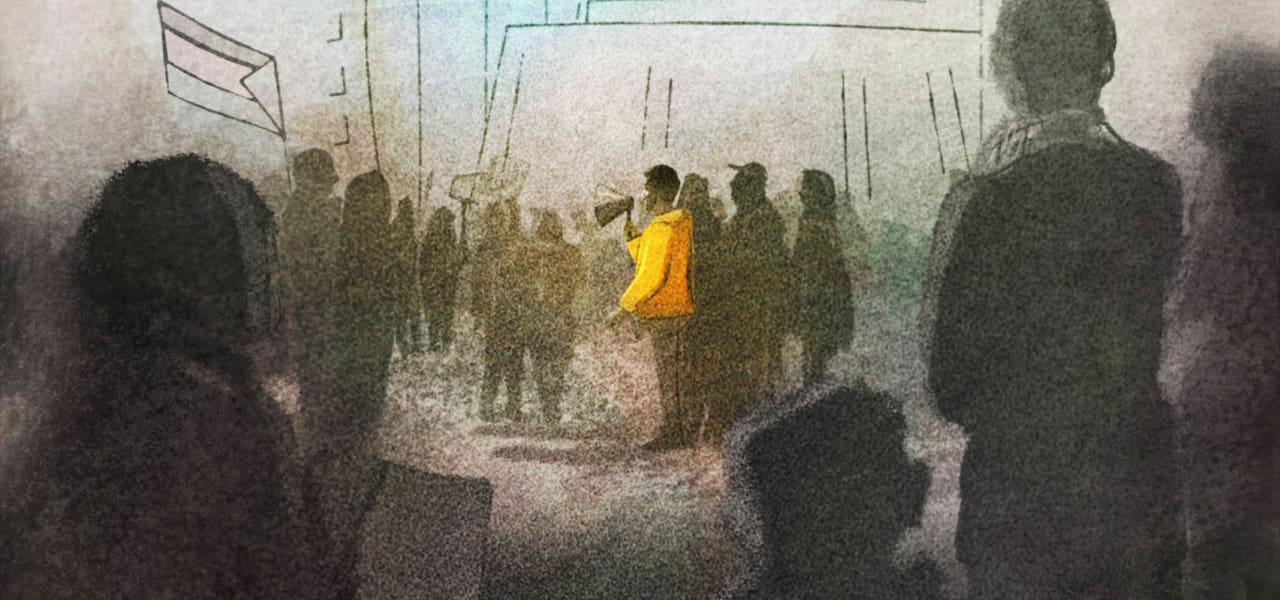
Mahmoud wrote these letters during a sleepless night, weeks into a 104-day detention. His words capture a dark night of the soul in a far-away jail. The style of the film intentionally weaves in and out of detail to express the restlessness, anxiety, bravery, despair, and hope that he experienced during the course of that night. And in the moments when we stylistically move away from realism, it’s also about showing how the immigration system dehumanizes people like Mahmoud and his fellow detainees, all of whom have unique stories and families that miss them.
This is a film about events that are still unfolding. Did that immediacy change the way you approached making it, or create a sense of urgency around getting it finished and seen?
Absolutely. We do a lot of work in the nonfiction and social justice space, where there’s often a finite timeline to work within. This film, and working with Mahmoud, was no different. During production (and unfortunately even still), Mahmoud faced ongoing threats of deportation, which made the urgency of completing and sharing his story all the more clear to our team and us.
Thankfully, we have an incredible community of artists from all around the world who came together to help tell this story. They poured their hearts and talents into the film at a fraction of the cost and the time it should have taken. It’s such an honor and privilege to work with them. The trust they put in us throughout production only underscores the importance of the next phase of this project: getting the film out into the world.
We’ve been deeply inspired by the people and organizations working alongside Mahmoud, not only in support of his rights, but in the broader fight for the rights of others. This film is one part of that much larger story. At its heart is Mahmoud’s letter: a powerful piece of writing that stands on its own. Whatever happens to him personally, the words themselves remain a wake-up call, a record of what he’s experienced, and an invitation to listen, engage, and consider what we do next.